Creatine is the most researched supplement in strength training, and it’s also one of the cheapest. It works. The confusing part is how much to take. Do you need to load? Is 5 grams enough if you weigh 100 kg? Does it cause hair loss or wreck your kidneys?
This guide answers all of that using the two papers that matter most: the International Society of Sports Nutrition (ISSN) position stand on creatine from Kreider and colleagues in 2017, and the 2021 follow-up Common questions and misconceptions about creatine supplementation from Antonio and colleagues. Use the calculator below to get your own numbers first.
Creatine Dosage Calculator
Enter your body weight. The calculator gives you a loading dose, a maintenance dose, and the no-loading option, all based on the ISSN numbers.
Find your creatine dose
How Much Creatine Should You Take Per Day?
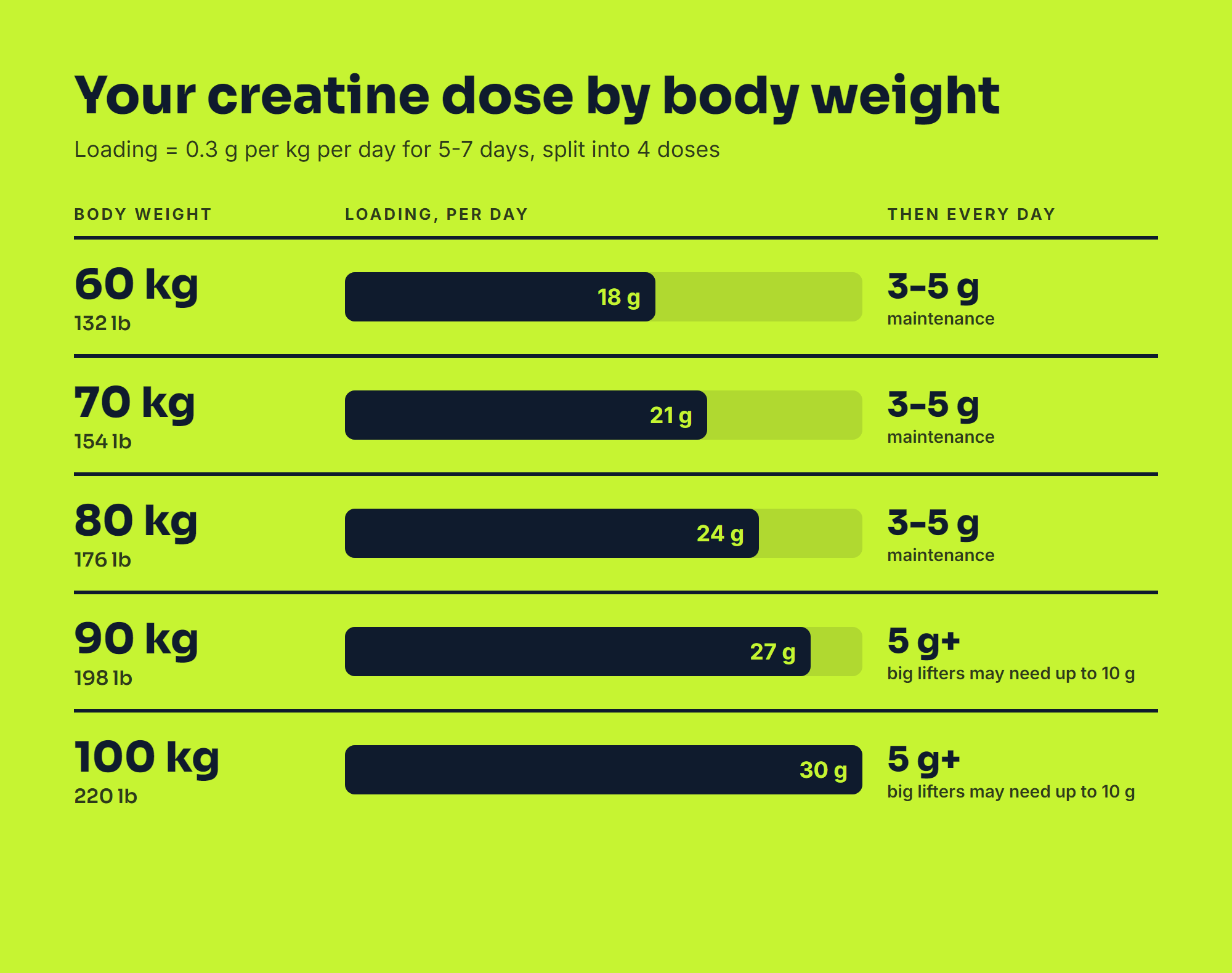
For most people the answer is simple: 3 to 5 grams of creatine monohydrate every day. That’s the maintenance dose in the ISSN position stand, and the 2021 review says the same thing, written another way: 3 to 5 g a day, or about 0.1 g per kg of body weight.
There’s one exception. The ISSN paper notes that “larger athletes may need to ingest as much as 5 to 10 g/day” to keep their stores full. If you’re well over 90 kg and carry a lot of muscle, 5 g is the floor, not the ceiling.
Creatine Loading: Do You Need It?
No. Loading is faster, but it isn’t required.
The loading protocol
The ISSN says the quickest way to fill your muscles is about 0.3 g per kg of body weight per day (roughly 5 g four times a day) for 5 to 7 days, then drop to 3-5 g a day. For an 80 kg lifter that’s 24 g a day for a week.
The no-loading protocol
Take 3 g a day from day one. You end up in the same place, it just takes about 28 days instead of a week. The ISSN notes this slower route “may have less effect on exercise performance” until your stores are full, so the only real cost is a few weeks.
Which one should you pick?
- Load if you want results fast, for example before a meet or a new training block.
- Skip loading if large doses upset your stomach, or you’re not in a rush. Most people who get bloating from creatine get it during loading.
How Creatine Actually Works
About 95% of your body’s creatine sits in skeletal muscle. Your muscles use it to rebuild ATP fast during short, hard efforts like a heavy set of squats or a sprint. More stored creatine means you can do a little more work before you fatigue, which adds up to more training volume over weeks and months. That’s where the extra muscle comes from. It’s not magic, it just lets you train harder. If you want the bigger picture of how training turns into muscle, read our guide to muscle protein synthesis.
Here’s why supplementing does anything at all:
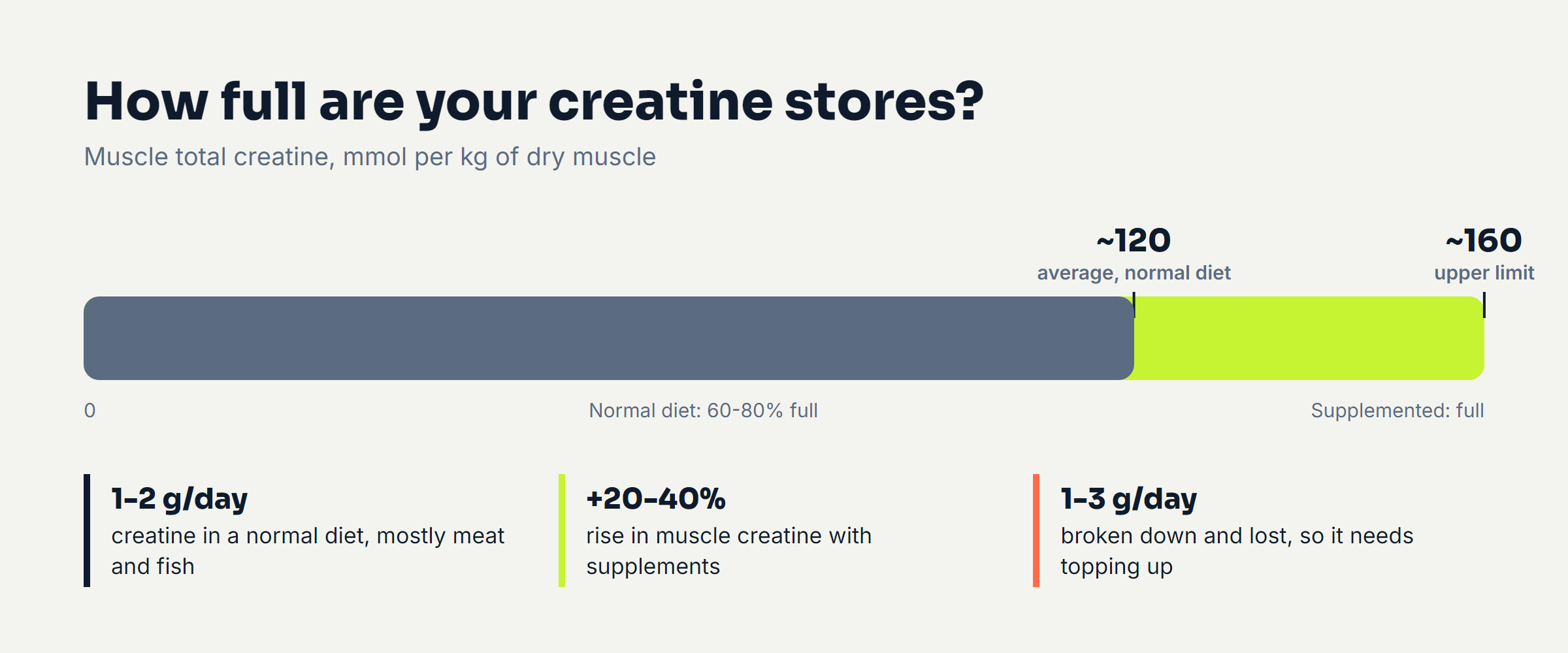
- A normal diet gives you about 1-2 g of creatine a day, mostly from meat and fish.
- That leaves your muscle stores only about 60-80% full.
- Your body breaks down and loses about 1-3 g a day, so it needs a steady supply.
- Supplementing raises muscle creatine by 20-40%, topping out around 160 mmol per kg of dry muscle.
This is also why vegetarians and vegans often notice a bigger effect. They start with lower stores because they don’t eat meat or fish.
When To Take Creatine
Timing matters far less than taking it every day. Your goal is to keep your muscles full, and that happens over days, not hours. Pick a time you’ll remember and stick with it.
One thing that does help: the ISSN notes that taking creatine with carbs, or carbs plus protein, “more consistently” improves how much your muscles hold on to. In practice, that just means taking it with a meal or mixed into your post-workout shake. If you’re also figuring out your protein, see our guide on eating for muscle gain.
Creatine Myths vs What The Research Says
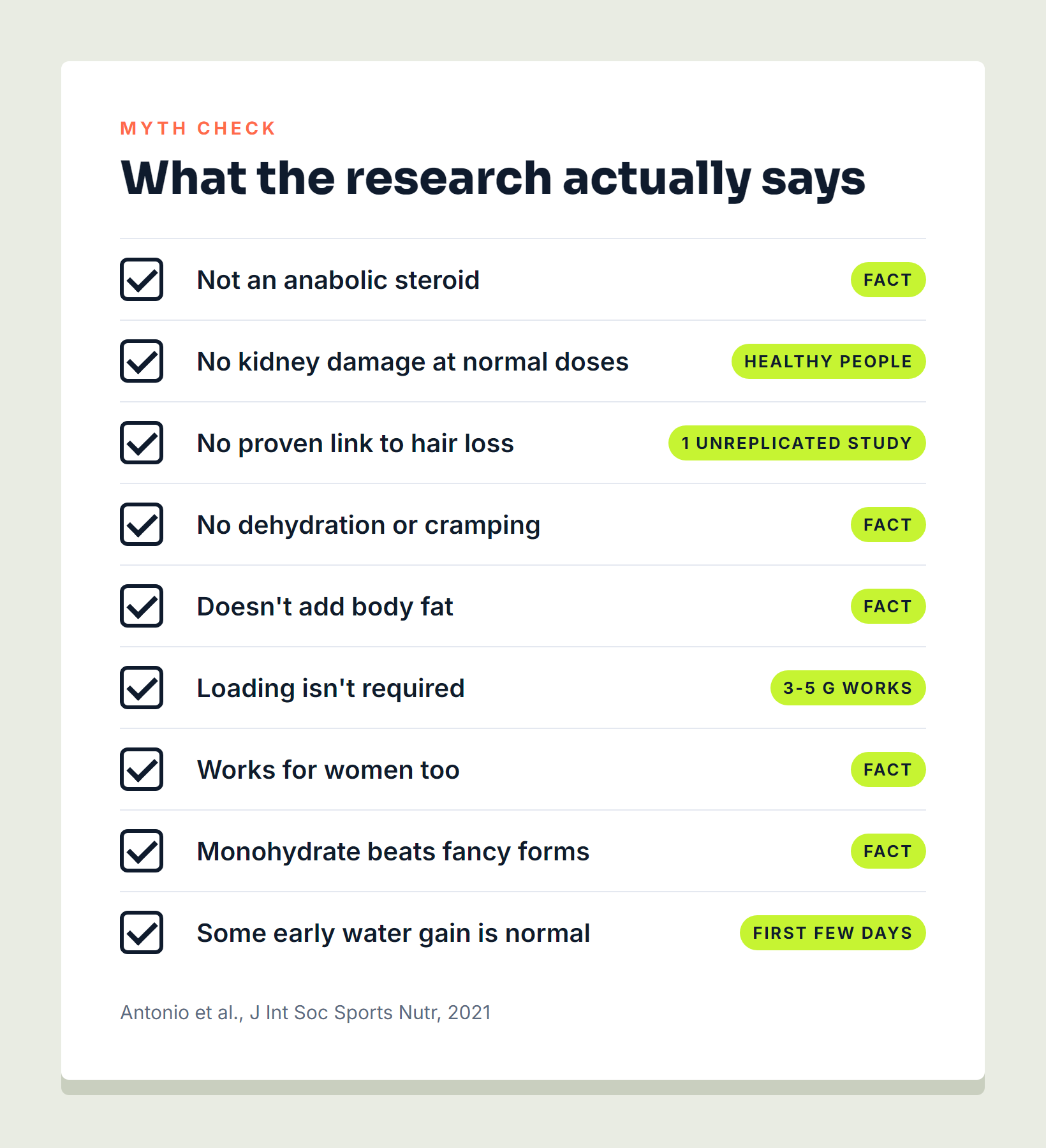
The 2021 review from Antonio and colleagues was written to settle the most common questions. Here’s what it concluded.
Does creatine cause water retention?
A little, early on. The review says water retention is the most common side effect, but it shows up “in the early stages (first several days)”, mostly with loading doses. It’s not a long-term bloat.
Does creatine damage your kidneys?
Not in healthy people at recommended doses. The review’s conclusion: creatine “does not result in kidney damage and/or renal dysfunction in healthy individuals.” The ISSN position stand adds that doses up to 30 g a day for 5 years were safe and well tolerated. If you already have kidney disease, talk to your doctor before taking it.
Does creatine cause hair loss?
There’s no good evidence it does. The whole idea comes from one small 2009 study of college rugby players where DHT (a hormone linked to hair loss) rose during creatine loading. That study has never been replicated, nobody measured actual hair loss, and the DHT levels stayed within normal clinical limits. The review says “the majority of available evidence does not support a link.”
Is creatine a steroid?
No. Creatine is a compound your body makes from amino acids and that you already eat in meat and fish. It has nothing in common with anabolic steroids.
Does creatine make you fat?
No. The review states creatine “does not increase fat mass.” Any early scale jump is water stored in muscle, not fat.
Does it cause cramps or dehydration?
No. That’s another myth the review rejects directly.
Is creatine only for men?
No. The review found creatine “provides a variety of benefits for females across their lifespan.” See our ffmi for women guide for how women can track muscle gain.
Which Type of Creatine Is Best?
Creatine monohydrate. It’s the form used in almost all the research, and the 2021 review concluded that “other forms of creatine are not superior to creatine monohydrate.” Creatine HCl, buffered creatine and creatine ethyl ester cost more and haven’t been shown to work better. Buy plain monohydrate, ideally a brand with third-party testing.
What Results Can You Expect?
Creatine helps most with short, hard efforts: heavy lifting, sprints and repeated high-intensity bouts. Combined with resistance training, it leads to more strength and lean mass than training alone. It also helps older adults hold on to muscle, especially when they lift.
Keep your expectations honest, though. Creatine adds a bit on top of good training, enough food and enough protein. It won’t replace any of them. For realistic numbers on how fast you can add muscle, see our guide to natural muscle gain rate, and use our lean body mass calculator to track whether that early scale jump turns into real muscle. Wondering what else is worth buying? Our supplement science breakdown ranks the rest.
Frequently Asked Questions
How much creatine should I take a day?
3 to 5 grams of creatine monohydrate a day works for most people. Larger, very muscular athletes may need 5 to 10 grams a day.
Do I need to do a creatine loading phase?
No. Loading at 0.3 g per kg per day for 5 to 7 days fills your muscles faster, but 3 g a day gets you to the same place in about 28 days.
How much creatine should I take during loading?
About 0.3 g per kg of body weight per day, split into 4 doses, for 5 to 7 days. That’s about 24 g a day for an 80 kg person.
When is the best time to take creatine?
Any time you’ll remember every day. Taking it with a meal that has carbs or carbs and protein can help your muscles hold more of it.
Is creatine bad for your kidneys?
Not in healthy people at recommended doses. If you have kidney disease, check with your doctor before using it.
Does creatine cause hair loss?
There’s no good evidence that it does. The idea comes from one small 2009 study that measured DHT, not hair loss, and it has never been replicated.
Does creatine make you gain water weight?
Some people gain a little water in the first several days, mostly during loading. It isn’t fat and it doesn’t keep building.
What is the best form of creatine?
Creatine monohydrate. Research has not shown any other form to be better.
Do I need to cycle creatine?
No. Studies have used daily creatine for years without problems in healthy people, so there’s no need to cycle off.
The Bottom Line
Take 3 to 5 g of creatine monohydrate every day, with a meal if you can. Load at 0.3 g per kg for a week if you want faster results, or skip it and be patient for a month. The kidney, hair loss and fat gain scares don’t hold up in the research. Keep lifting hard, eat enough protein, and let creatine do its small but real part.
This article is for information only and isn’t medical advice. Talk to a doctor before starting any supplement if you have a medical condition. Last reviewed 2026-10-08.