You can train hard and eat enough protein and still leave gains on the table if you’re sleeping five or six hours a night. Sleep isn’t just “recovery” in the vague sense. It changes how fast your muscles build protein, how much muscle you hold on to during a cut, and how much work you can do in the gym.
This guide covers what the research actually shows about sleep and muscle growth, how much sleep you need, and what to do when you can’t get enough. There’s a bedtime and sleep-debt calculator below.
Sleep Calculator for Lifters
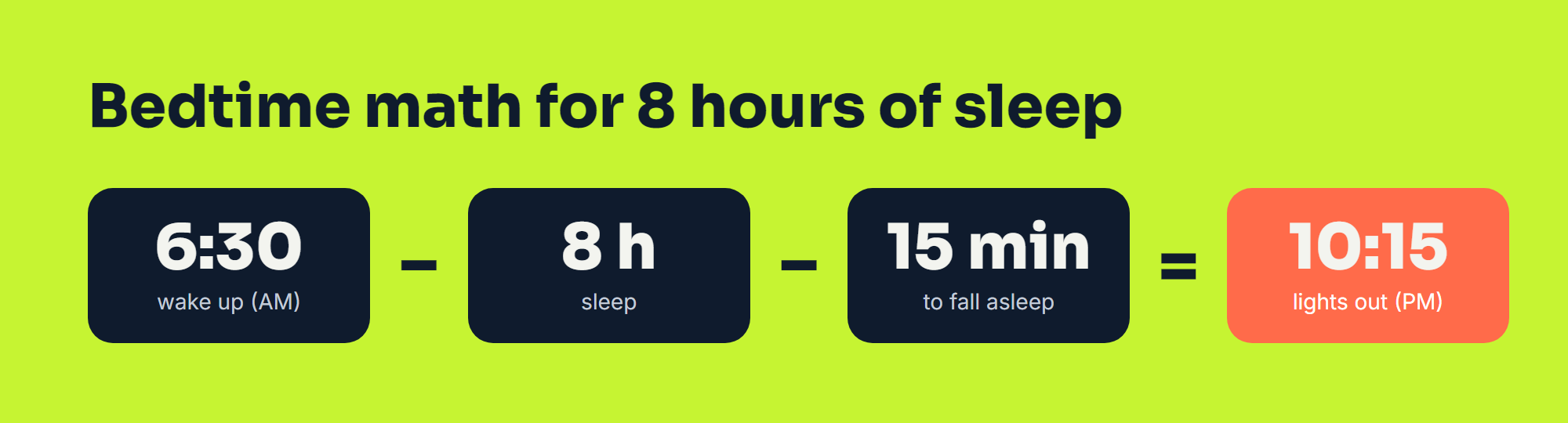
Enter when you need to wake up, how long it usually takes you to fall asleep, and how much you actually sleep on a typical night. The calculator gives you a lights-out time for 7, 8 and 9 hours of sleep and shows how much sleep you’re missing each week compared with the 7-hour minimum.
Lights-out time = wake-up time minus your sleep target minus the time it takes you to fall asleep. Weekly shortfall assumes the same sleep every night. Seven hours is the minimum for adults in the AASM and Sleep Research Society consensus; many lifters do better with more.
How Much Sleep Do You Need to Build Muscle?
The American Academy of Sleep Medicine and the Sleep Research Society recommend at least 7 hours a night for adults. That's the floor for general health, not a target for people trying to recover from hard training. No study has found a magic number for muscle growth specifically, but the research below compares 4 to 5.5 hours against 8 to 8.5 hours, and the longer sleep wins every time.
A practical target for lifters: 7 to 9 hours of actual sleep, not just time in bed. If you need 15 minutes to fall asleep and wake up once or twice, 8 hours in bed might only give you about 7.5 hours of sleep.
What Happens to Your Muscles When You Don't Sleep
Muscle protein synthesis drops
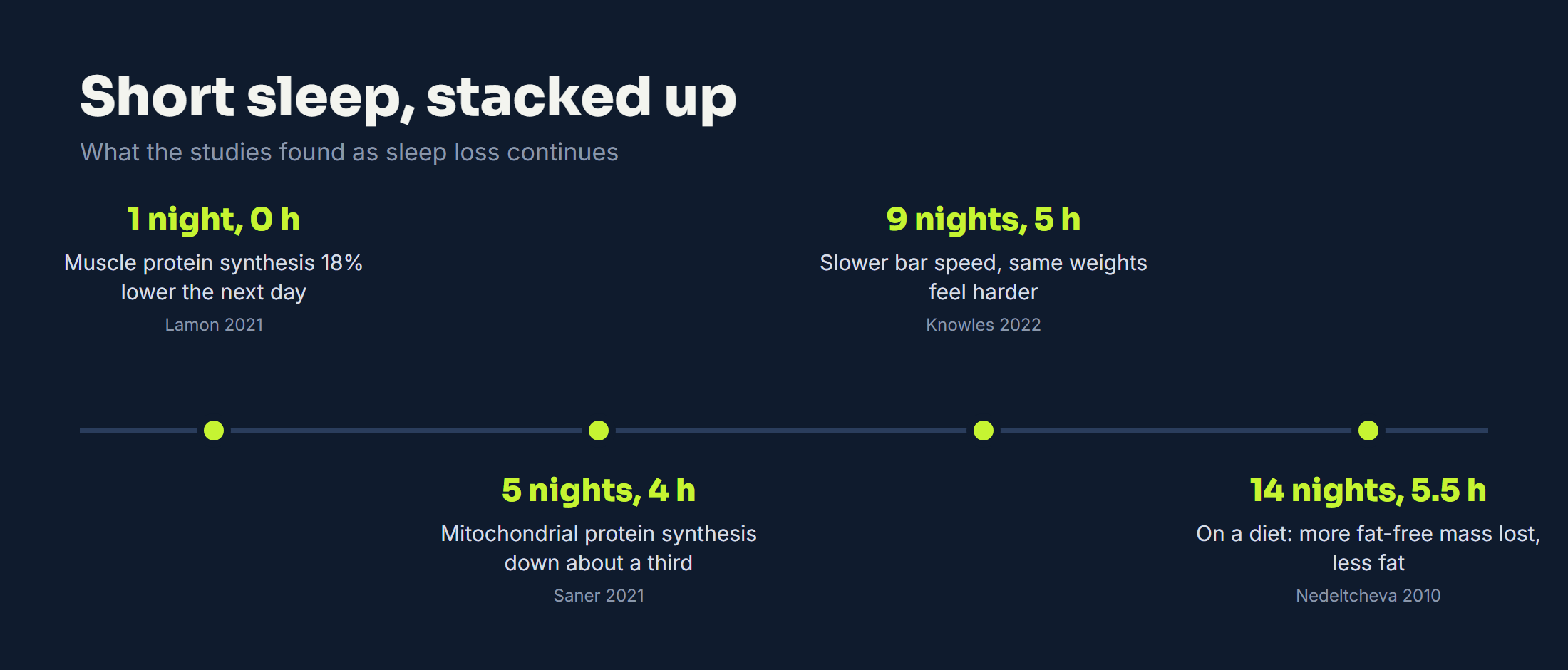
Muscle grows when muscle protein synthesis (MPS) beats muscle protein breakdown over time. In a 2021 study by Lamon and colleagues, 13 young adults spent one night with no sleep and, in a separate trial, one night of normal sleep. The next afternoon, after a meal, their muscle protein synthesis was 18% lower after the sleepless night.
The hormone picture shifted too. Cortisol (a catabolic hormone) went up 21%, and testosterone went down 24%. Markers of protein breakdown didn't change. The authors called it "anabolic resistance": the same meal produced less muscle building.
| Measure (day after) | One night of no sleep vs normal sleep |
|---|---|
| Muscle protein synthesis after a meal | 18% lower |
| Plasma cortisol | 21% higher |
| Plasma testosterone | 24% lower |
| Protein breakdown markers | No difference |
That's a single night of total sleep loss, which is extreme. But most people don't pull all-nighters. They sleep a bit too little, night after night.
Several short nights add up
Saner and colleagues (2021) put 24 young men on either 8 hours or 4 hours in bed for five nights. The sleep-restricted group had lower glucose tolerance, worse mitochondrial function and a lower rate of sarcoplasmic protein synthesis (the protein-building in the part of the muscle cell rich in mitochondria): about 1.11% per day versus roughly 1.73% with normal sleep, a drop of about a third.
The interesting part: a third group also slept 4 hours a night but did three high-intensity interval sessions during those five days. Their protein synthesis and glucose tolerance held up. Training doesn't replace sleep, but it seems to blunt some of the damage.
Sleep and Muscle Loss on a Cut
This is the study every lifter who diets should know. Nedeltcheva and colleagues (2010) put 10 overweight adults on the same reduced-calorie diet for 14 days, twice: once with 8.5 hours in bed, once with 5.5 hours.
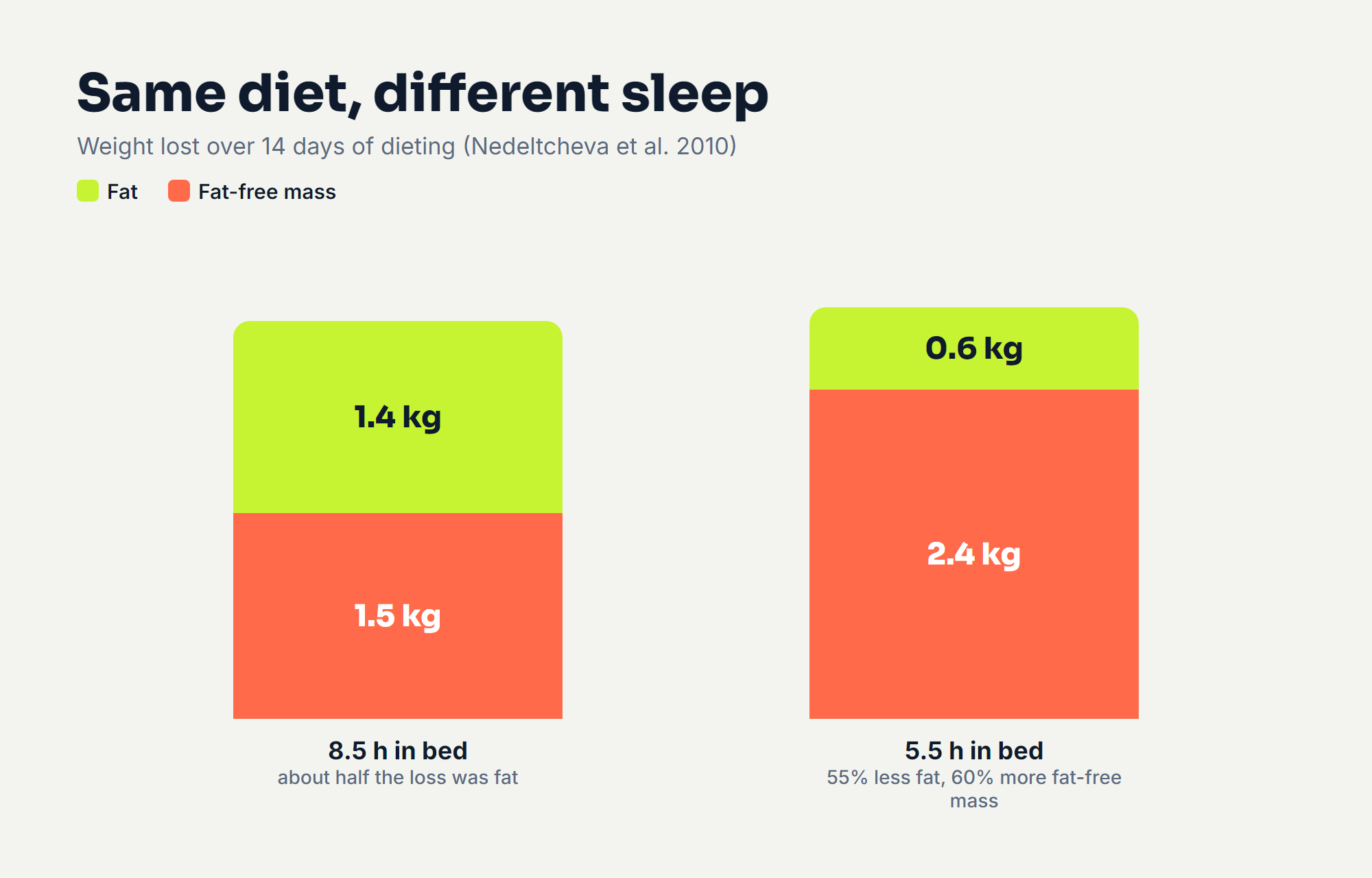
| 14 days of dieting | 8.5 h in bed | 5.5 h in bed |
|---|---|---|
| Fat lost | 1.4 kg | 0.6 kg |
| Fat-free mass lost | 1.5 kg | 2.4 kg |
| Hunger | Lower | Higher |
Total weight loss was similar, but the short-sleep condition lost 55% less fat and 60% more fat-free mass. Fat-free mass includes water and glycogen, not only muscle, and the study was small and short. Still, if you're cutting and trying to keep your FFMI where it is, short sleep pushes the scale in exactly the wrong direction. See our guide on how to lose fat and keep muscle for the rest of the plan.
Sleep and Strength in the Gym
Muscle growth depends on the training you can actually do. A 2018 systematic review by Knowles and colleagues looked at 17 studies on sleep loss and resistance exercise:
- One night of no sleep had little effect on muscle strength.
- Several nights of short sleep could reduce force in multi-joint lifts like squats and bench press, but not single-joint movements like curls.
A 2022 follow-up in resistance-trained women tested nine nights at 5 hours in bed against normal sleep. Total volume load barely dropped, but bar speed fell and the same weights felt harder. In other words, you can still grind out your sets on short sleep, but the quality of the work goes down and the effort goes up.
What Happens While You Sleep
Overnight is the longest stretch of the day without food, which means a long stretch with no new amino acids coming in. Muscle keeps turning over, and without protein the balance tips slightly toward breakdown.
That's the idea behind pre-sleep protein. In a 12-week study by Snijders and colleagues (2015), 44 young men followed a progressive resistance training program. Half had a 27.5 g protein drink every night before bed; the other half had a non-caloric placebo. The protein group gained more:
| 12 weeks of training | Protein before bed | Placebo |
|---|---|---|
| Strength gain (1RM tests) | +164 kg | +130 kg |
| Quadriceps cross-sectional area | +8.4 cm² | +4.8 cm² |
One caveat: the placebo had no protein at all, so the protein group simply ate more protein per day. This shows that extra protein helps, not that bedtime is a magic window. If you're already hitting your daily protein target, a pre-bed shake is a convenient way to get there, not a requirement. More on that in our muscle protein synthesis guide.
How to Sleep Better for Muscle Growth
- Protect 7 to 9 hours. Work backward from your wake-up time using the calculator above and treat lights-out like a training session you don't skip.
- Keep the same schedule on weekends. A big lie-in on Saturday may not fully pay back a week of short nights, and it shifts your body clock.
- Cut caffeine earlier. Pre-workout late in the afternoon can still be in your system at bedtime. If you train in the evening, try a stim-free pre-workout.
- Make the room dark, cool and quiet. Blackout curtains or a sleep mask are cheap and work.
- Don't train to failure late at night if it wrecks your sleep. Some people sleep fine after evening sessions, some don't. Track it.
- Get protein in your last meal. A protein-rich dinner or a casein shake covers the overnight gap.
What to Do When You Can't Get Enough Sleep
New parents, shift workers and students all go through stretches of bad sleep. The research points to a few damage-control moves:
- Keep training. In the Saner study, exercise prevented the drop in protein synthesis and glucose tolerance seen with short sleep alone.
- Lower your expectations for top sets. Multi-joint strength and bar speed suffer first, so this isn't the week to test a max. Keep the weight, accept fewer reps, or take a deload week if it drags on.
- Hit your protein every day. Anabolic resistance means you get less out of each meal, so don't give it fewer meals to work with.
- Avoid aggressive cuts. Short sleep plus a big deficit is the combination most likely to cost you muscle. Eat closer to maintenance until sleep improves.
- Use caffeine strategically. The Knowles review lists caffeine and training with others as ways to keep performance up during short sleep. Just keep it away from bedtime.
Frequently Asked Questions
Do muscles grow while you sleep?
Muscle repair and growth happen around the clock, not only at night. But sleep loss lowers muscle protein synthesis the next day, raises cortisol and lowers testosterone, so poor sleep slows the process.
How many hours of sleep do I need to build muscle?
At least 7 hours, the adult minimum from the AASM and Sleep Research Society. Studies comparing 4 to 5.5 hours with 8 to 8.5 hours consistently favor the longer sleep, so 7 to 9 hours of actual sleep is a good target.
Can you build muscle on 6 hours of sleep?
Yes, but probably less efficiently. Short sleep reduces training quality and protein synthesis, and during a diet it shifts weight loss away from fat and toward fat-free mass.
Does one bad night ruin my gains?
No. One night of no sleep lowered muscle protein synthesis by 18% the next day in one study, but it had little effect on strength. It's chronic short sleep that adds up.
Should I take protein before bed?
It can help if it gets you to your daily protein target. In one 12-week study, 27.5 g of protein before bed led to more muscle and strength gains than a placebo, but the placebo group ate less protein overall.
Do naps help muscle growth?
Naps can make up some lost sleep and help performance, but they haven't been tested as a replacement for nighttime sleep for muscle growth. Use them as a top-up, not a substitute.
The Bottom Line
Sleep is part of your program. One sleepless night cuts muscle protein synthesis by about a fifth, a week of short nights makes your lifts slower and harder, and dieting on 5.5 hours shifts weight loss from fat toward fat-free mass. Aim for 7 to 9 hours of actual sleep, keep training and eating enough protein when you can't get it, and use the calculator above to set a bedtime that works.
This article is for education, not medical advice. If you snore loudly, wake up gasping or feel exhausted despite enough time in bed, talk to a doctor. Studies cited: Lamon et al. 2021 (Physiological Reports), Saner et al. 2021 (Molecular Metabolism), Nedeltcheva et al. 2010 (Annals of Internal Medicine), Knowles et al. 2018 (Journal of Science and Medicine in Sport), Knowles et al. 2022 (Medicine and Science in Sports and Exercise), Snijders et al. 2015 (Journal of Nutrition).