A deload week is the week you deliberately train easier so the hard weeks keep working. Almost every serious lifter does them, yet the research on deloading is surprisingly thin, and some of it says the opposite of what gym folklore claims.
This guide covers what a deload actually is, what the studies found, how competitive lifters really deload, and how to plan your own. There’s a free deload planner below.
Deload Week Planner
Enter what a normal week looks like for one muscle group or lift. The planner suggests a deload week and your next deload date. The reductions it uses are common practical starting points, not fixed rules from research.
Starting points: volume deload = about half the sets; weight deload = about 10-15% lighter; both = about half the sets at about 10% lighter. Keep your training days and exercises the same. Stop 3 or more reps short of failure.
What Is a Deload Week?
In 2023, a panel of expert strength and physique coaches agreed on a formal definition through a three-round Delphi consensus study:
“Deloading is a period of reduced training stress designed to mitigate physiological and psychological fatigue, promote recovery, and enhance preparedness for subsequent training.”
Two parts of that matter. First, it’s reduced training, not no training. Second, its job is to set up the next block, not to build muscle by itself. A deload is a tool for managing fatigue, the same way a progressive overload plan is a tool for driving progress.
How Competitive Lifters Actually Deload
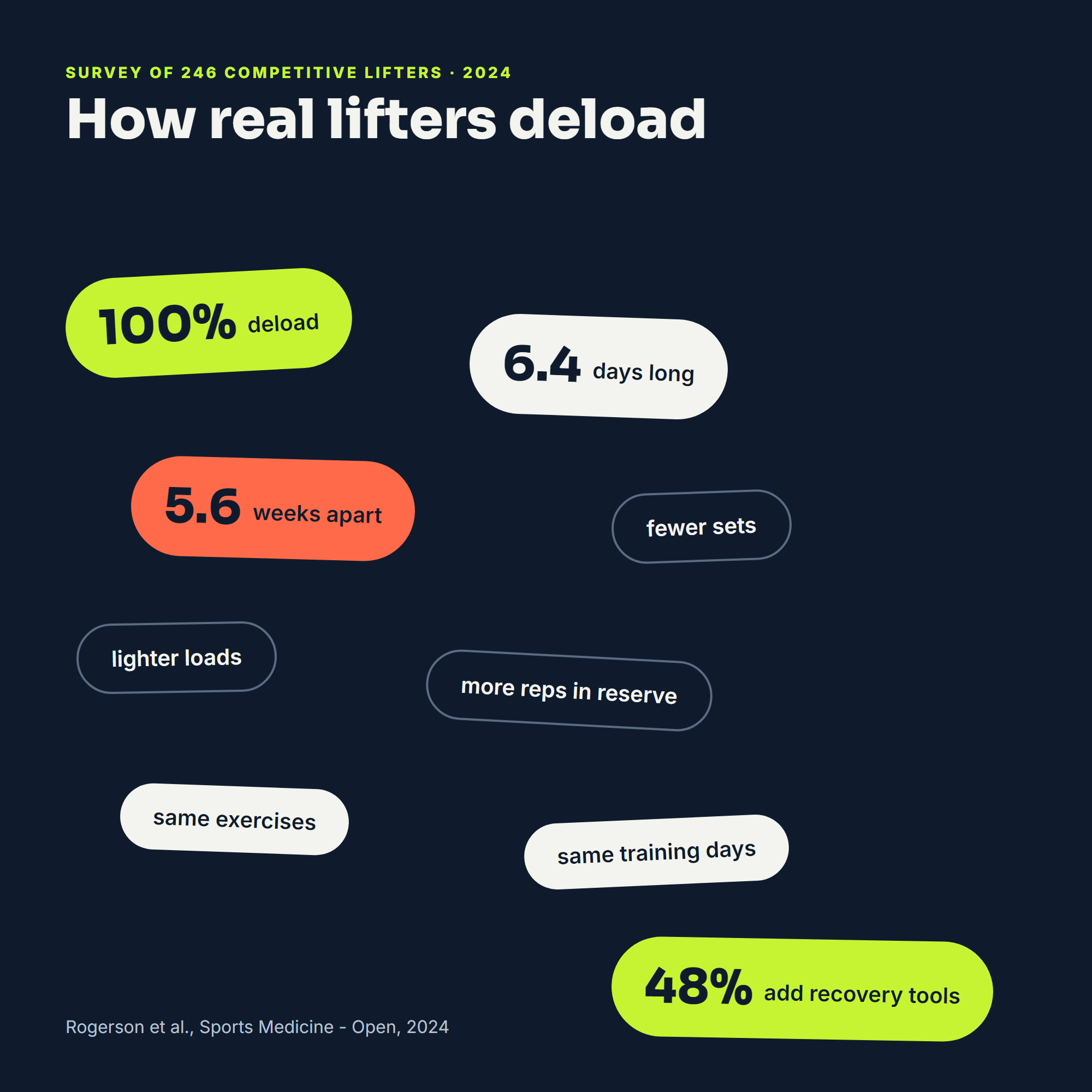
A 2024 survey of 246 competitive strength and physique athletes, averaging 8 years of lifting, gives the best picture of real-world practice:
| What they reported | Typical answer |
|---|---|
| Do they deload? | All 246 did |
| Main reason | Managing energy and fatigue |
| How long | About 6.4 days (± 1.7) |
| How often | Every 5.6 weeks (± 2.3) |
| Planned or reactive? | Mostly pre-planned, sometimes combined with deloading when performance stalls or joints ache |
| Volume | Reduced: fewer reps per set and fewer sets per week |
| Load and effort | Lighter weights, more reps in reserve |
| Frequency and exercises | Usually unchanged |
| Extra recovery tools | 48% added some, mostly massage, static stretching and foam rolling |
So the “typical” deload is about one week, every five to six weeks, training the same days with the same exercises, but with fewer sets, lighter weights and easier effort.
What the Research Says About Results
Only a handful of controlled trials exist, and they tested different kinds of deloads. That difference is the key to reading them.
A full week off cost some strength
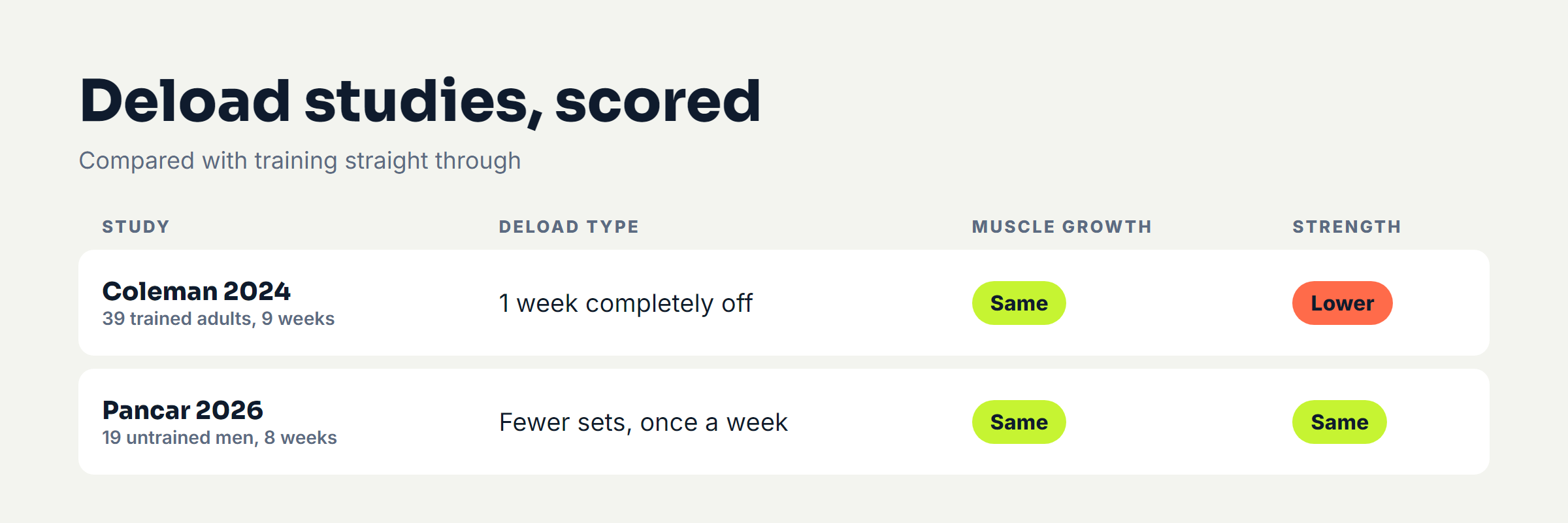
In a 2024 PeerJ study, 39 trained men and women ran a 9-week high-volume program. One group took a full week off at the midpoint; the other trained straight through. Muscle growth, power and muscular endurance in the lower body were about the same. But the group that kept training gained more isometric and dynamic lower-body strength, and also scored slightly better on readiness to train.
Note what was tested: complete time off, not a lighter week. That’s a “detraining” week, which is different from how most lifters deload.
A lighter week didn’t hurt
A 2026 Scientific Reports study had 19 untrained young men train one arm and one leg continuously and the other arm and leg with deloads in weeks 4 and 8 (one session a week, 2 sets instead of 6-8). After 8 weeks, muscle thickness and 10-rep-max strength improved about equally in both limbs, with no meaningful difference between conditions.
| Study | Who | Deload type | Muscle growth | Strength |
|---|---|---|---|---|
| Coleman et al., 2024 | 39 trained adults, 9 weeks | 1 week completely off | No difference | Lower with the week off |
| Pancar et al., 2026 | 19 untrained men, 8 weeks | Reduced sets and frequency, weeks 4 and 8 | No difference | No difference (10RM) |
What that means for you
- Don’t expect a deload to build muscle. No study shows a deload makes you grow faster. The idea that a week off “resensitizes” muscle hasn’t produced extra growth in trials so far.
- A lighter week seems safer than a week off, at least for strength. You keep practicing the lifts.
- The real benefit is probably fatigue and joint management, which these short studies don’t measure well. That’s exactly why experienced lifters use them.
Signs You Need a Deload
Planned deloads every 4-8 weeks are the most common approach. But the survey also showed lifters deload reactively when they notice:
- Performance stalling or dropping for 2 or more sessions in a row on main lifts
- Joint aches or nagging soreness that isn’t going away
- Unusual muscle soreness that lasts longer than normal
- Low motivation and dread before sessions
- Sleep getting worse despite the same routine
One bad day isn’t a reason to deload. A trend over a week or two is. Tracking your lifts makes this obvious; see our guide on tracking strength gains.
How to Structure a Deload Week
There are three common ways to do it. All of them keep your normal training days and exercises.
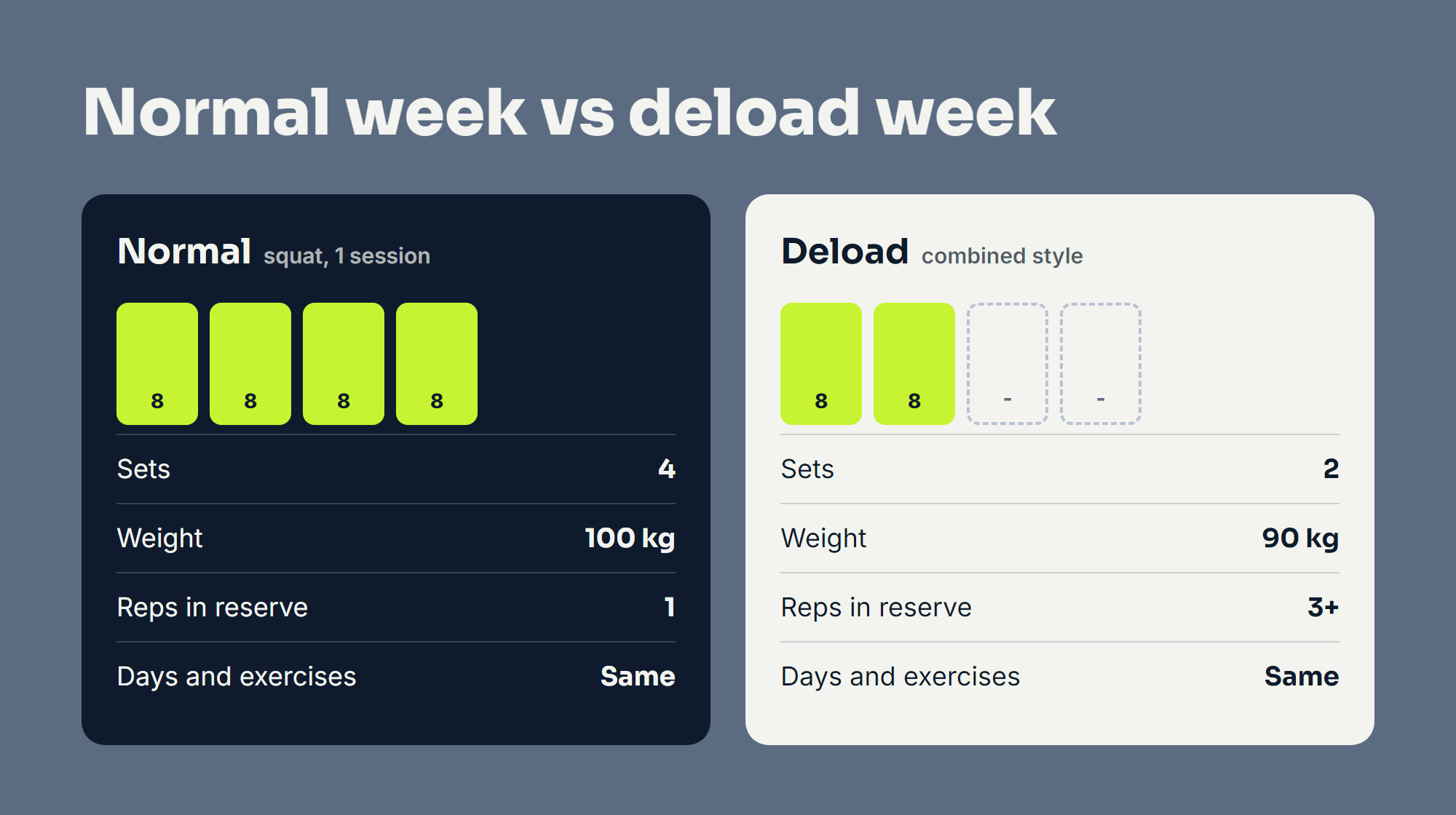
| Style | What changes | Example (normal: 4 × 8 at 100 kg, 1 RIR) | Best for |
|---|---|---|---|
| Volume deload | About half the sets, same weight | 2 × 8 at 100 kg, 3+ RIR | Keeping strength sharp, beginners |
| Load deload | Same sets, about 10-15% lighter | 4 × 8 at 87.5 kg, 3+ RIR | Achy joints, technique work |
| Combined | About half the sets, about 10% lighter | 2 × 8 at 90 kg, 3+ RIR | High-volume or advanced lifters |
These percentages are practical starting points that line up with what athletes report doing. They aren’t figures proven in trials. The one rule that matters most: leave several reps in the tank on every set. A deload done to failure is just a short training week.
How Often Should You Deload?
- Beginners (under a year of training): you usually don’t need planned deloads. Your training stress is low and progress is fast. Take an easier week when life or joints demand it.
- Intermediate lifters: every 6-8 weeks, or when progress stalls.
- Advanced or high-volume lifters: every 4-6 weeks, matching the survey average of about 5.6 weeks.
- During a cut: fatigue builds faster in a calorie deficit, so you may need deloads a bit more often. See how to lose fat and keep muscle.
Common Deload Mistakes
- Turning it into a week off. Unless you’re injured or sick, the 2024 study suggests a lighter week beats a complete break for strength.
- Cutting protein and calories. Keep eating normally. Your body is still repairing. Our muscle protein synthesis guide explains why.
- Testing maxes. A deload week isn’t the time for PRs. Save that for the week after.
- Adding “bonus” cardio or classes. Replacing lifting stress with other hard training defeats the point.
- Deloading too often. If you need one every 2-3 weeks, your normal training volume is probably too high. Revisit your training volume.
Frequently Asked Questions
How long should a deload last?
About a week. Competitive lifters in a 2024 survey averaged 6.4 days.
Will I lose muscle during a deload week?
No. Neither controlled trial found less muscle growth with a deload, even with a full week off. Muscle loss from detraining takes much longer than a week.
Should I still go to the gym during a deload?
Yes. Keep your normal days and exercises, just with fewer sets, lighter weight or both, and stop well short of failure.
How often should I deload?
Most lifters deload every 4-8 weeks. Athletes in the 2024 survey averaged every 5.6 weeks. Beginners often don’t need planned deloads.
Does a deload make you stronger?
Not directly. In one study, a full week off led to smaller strength gains than training straight through. A lighter week didn’t reduce strength in another study. The benefit is managing fatigue so later training goes better.
Is a deload the same as a rest week?
No. A rest week means no training. A deload means lighter training. The research so far favors the lighter week for strength.
The Bottom Line
A deload week is a planned, lighter week (about half the sets, a bit less weight, lots of reps in reserve) taken every 4-8 weeks or when fatigue piles up. It won’t build muscle by itself, and a full week off may cost a little strength, but a well-run lighter week keeps you training hard for longer. Use the planner above to put your next one on the calendar.
This article is for education, not medical advice. Studies cited: Bell et al. 2023 (Sports Medicine – Open), Rogerson et al. 2024 (Sports Medicine – Open), Coleman et al. 2024 (PeerJ), Pancar et al. 2026 (Scientific Reports).